Monday, 28 December 2015

(32) The Daily Telegraph fined £30,000 for email instructing readers to vote Conservative

Link: http://www.independent.co.uk/news/media/press/the-daily-telegraph-fined-30000-for-email-instructing-readers-to-vote-conservative-a6781326.html

 The Telegraph is Britain’s biggest-selling broadsheet newspaper
 
Summary:
 
The Daily Telegraph has been fined £30,000 by the Information Commissioner’s Office (ICO) after it sent hundreds of thousands of emails on the day of the general election urging readers to vote Conservative. The ICO found that Telegraph Media Group broke direct marketing rules when it issued the letter from Chris Evans, Daily Telegraph editor, which was attached to the paper’s usual morning e-bulletin. Steve Eckersley, ICO head of enforcement, said the paper had been negligent when it decided to send the campaign letter as part of the legitimate daily email.

Key data/statistical information:

  • Mr Evans described the May 7 general election as the “most important since 1979.” He wrote: “The Daily Telegraph urges its readers to vote Conservative.”
  • These circumstances, along with the small number of complaints (17), were factors when deciding the £30,000 fine, imposed on the Telegraph’s parent company.

What's my view?

I think that newspapers do try and promote and push their views to the people especially when it comes to politics. However, I'm not sure whether this "fine" is going to affect The Daily Telegraph's future conduct. One way or another newspapers will find ways to persuade people to believe what they think is right which supports the hypodermic needle theory. The audience is usually persuaded by celebrities or what they read in the news.


(31) Facebook and Uber team up to offer Messenger users taxi trips

Link: http://www.telegraph.co.uk/technology/facebook/12054819/Facebook-and-Uber-team-up-to-offer-Messenger-users-taxi-trips.html

An Uber car is seen parked with the driver's lunch left on the dashboard in Venice, Los Angeles, California, United States
 
Summary:
 
Facebook Messenger users can now order taxis from Uber via the social network. The social network revealed on Wednesday that it has launched a Transportation option on its messaging service. This will allow people to hail a cab from Uber without them having to download and use the taxi-hailing app's own site. Uber will also provide updates on waiting times via Messenger. Facebook said its Uber service is "currently in testing" and will only be available in areas where Uber already operates in the US.

Key data/statistical information:

  • With more than 1.4bn people using Facebook every month, the deal could unlock a huge revenue stream for both firms.
  • Uber's last funding round valued the private company at $50bn, and linking up with the world's largest social network could also make it more socially acceptable.
  • TfL is consulting on 25 proposals for private hire companies - several of which could seriously affect Uber

What's my view?


I think that this would help to make Uber more popular as Facebook is one of the popular social networking sites that people use today and would find it an easy access for them is they could call for an Uber driver through the use of this. This shows that social media is definitely making things easier for todays generation which encourages the pluralistic view.


Saturday, 26 December 2015

(30) Can Donald Trump's social media genius take him all the way to the White House?

Link: http://www.theguardian.com/technology/2015/dec/23/donald-trump-social-media-strategy-internet-republican-nomination-president

donald trump
 
Summary:
 
Donald Trump is still riding high in the polls as part of his bid to be the next President of the United States. If there’s anything that goes some way to explaining Trump’s popularity in the midst of his quasi-fascistic views that reached a nadir with his call to ban all Muslims from entering the United States, it is his social media prowess. Trump is fond of posting short clips to Instagram, as well as Vine, Twitter and Facebook. The brief videos evolved from his presence on YouTube (the Trump channel now has upwards of 1.3m views). Most of the clips consist of him yelling into a camera, flecks of spittle hitting the lens.

Key data/statistical information:

  • Trump has more than 5.5 million Twitter followers and 4.5 million Facebook fans.
  • Donald Trump, in many ways, is carrying the baton from Barack Obama’s successful 2008 election campaign, which some called the Facebook election.

What's my view?

I think it is funny that what used to be something controlled by the elite people is now being used by them to gain power. Social media is now a key way to get the audience's votes and attention. This shows the pluralistic view point because through social media, the audience go get a say. We can decide to follow Trump on social media and increase his chances of becoming president or decrease it by using social media to go against his views.


(29) Sun website traffic rises by a quarter – but it is eclipsed by the Mirror

Link: http://www.theguardian.com/media/2015/dec/17/sun-website-traffic-mirror

The Sun reported a 25.6% rise in daily unique browsers to 1.6 million in November


Summary:

The Sun’s website traffic rose by more than a quarter in November – but it was not enough to close the gap with rival Trinity Mirror. Mirror.co.uk editiorial director Pete Picton said the the site’s rolling coverage of last month’s Paris terror attacks had helped it bring in a record 77.99m unique browsers over the whole month. “The Paris terror attacks was a major contributory factor, accounting for more than 14m unique browsers alone,” he said.

Key data/statistical information:

  • News UK’s website, which began offering most online articles for free this summer and had completely abolished its paywall by the end of November, posted a 25.6% rise in daily unique browsers to 1.6 million.
  • Trinity’s national newspaper sites, which include mirror.co.uk, enjoyed a 28.1% rise in average daily unique browsers to 4.7 million last month compared with October, according to the latest figures from the Audit Bureau of Circulations.
  • The Independent was up 24.4% compared with October to 3.27 million daily unique browsers, Telegraph.co.uk jumped 17.2% to just over 5 million, theguardian.com rose 13.7% to 9.27 million and MailOnline added 10.5% to 14.6 million.
  • The Evening Standard posted the biggest rise of 29.2% to almost 520,000 daily unique browsers.

What's my view?

I think it is normal that website traffic has increased during the period of the Paris terror attacks due to the fact that people want to find out what has happened and get the inside story- even the younger ones. Therefore most would turn to on-line newspapers to get their information.

Thursday, 17 December 2015

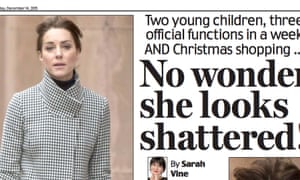
(28) Daily Mail is cruel and childish about the Duchess of Cambridge

Link: http://www.theguardian.com/media/greenslade/2015/dec/14/daily-mail-is-cruel-and-childish-about-the-duchess-of-cambridge

The Daily Mail’s page 3 “story” on the Duchess of Cambridge.
 
Summary: 

The Daily Mail has made absurd claims about the Duchess of Cambridge (the former Kate Middleton) based on a couple of photographs of her taken in a London street.

Key data/statistical information:

  • Some online critics unkindly suggested that Kate - wrapped up in a £325 houndstooth coat from Reiss – looked closer to 40 than 30.

What's my view?


It was one of the most risible and childish pieces of journalism ever read, even by the low standards of royal “reporting”. But it was also unnecessarily personal and nasty. Sometimes the news industry can go over the top when talking about celebrities just to get readers. Personally, I think being famous comes with a price but journalists should watch what they say about celebrities especially in the royal family.

Tuesday, 15 December 2015

(27) Twitter warns users they may have been hacked by 'state-sponsored actors'

Link: http://www.theguardian.com/technology/2015/dec/14/twitter-warns-users-hacked-state-sponsored-actors

The logo of Twitter on the front of the New York Stock Exchange (NYSE) in New York.

Summary:

Twitter has warned a number of users that they may have been the target of a state-sponsored attack. The warning begins: “As a precaution, we are alerting you that your Twitter account is one of a small group of accounts that may have been targeted by state-sponsored actors. We believe that these actors (possibly associated with a government) may have been trying to obtain information such as email addresses, IP addresses, and/or phone numbers.” Twitter’s specific warning has sparked criticism from those who received it, however.

Key data/statistical information:

  • Social media company emails more than 20 users, warning them they may have been targeted by hackers ‘possibly associated with a government’
  • Google’s warnings were introduced in 2012, while Facebook began sending its own in October this year.

What's my view?

It's interesting to see that twitter has included the detail to their users that the hackers could have been associated with a government. Even though we are not sure why they would want to hack people's users accounts, I think it is good that twitter did not leave out the specific detail of who has hacked into people's accounts. It shows that twitter is uncensored and not biased.

Monday, 14 December 2015

NDM: The key concepts of audience and institution

our Media Magazine archive MM52 page 9
Read the article and complete the following tasks:

1) What was the relationship between audience and institution in the pre-digital age?


In the pre-digital age, media products were produced by economically powerful organisations which packaged and sold them to carefully defined audiences. They had a relationship which allowed them to become connected and powerful.
 

 2) The article gives a lot of examples of major media institutions. Choose three examples from the article and summarise what the writer is saying about each of them.

  
The BBC: Due to the fact it is funded by a licence fee and it has a public service remit, it is more likely to screen programmes with a regional interest than other broadcasters.
 
The MailOnline: It receives more income the longer a reader stays on the site, so stories will feature lots of images and videos, and sensationalised or controversial headlines will be constructed to ‘tempt’ readers to ‘click through’.

 ITV: It relies on income generated by advertisers. This means that appeal to a large audience are seen as more valuable than ones with smaller niche audiences

 3) The article ends with a section on the digital age. Summarise this section in 50 words.

 
It is still to early in the digital age so its a very uncertain time for media institutions. However it is clear that not all traditional media forms, outlets or institutions will be able to maintain their place in the media marketplace. As audiences reject traditional TV programming,newspapers and cinema exhibition, the only thing we know for sure about the future is that institutions will continue to come up with increasingly sophisticated and creative ways to try to find and attract an audience.
 

4) How do YOU see the relationship between audience and institution in the future? Will audiences gain increasing power or will the major global media institutions hold sway?

 
At the moment audiences have more freedom to access media products when they choose, rather than when they are told. Mobile technology allows audiences to carry TV programmes, films, music and all that is on offer on the internet on tablets and smartphones. Modern audiences now expect to be able to communicate directly with institutions, and to be able to construct their own media products for themselves. In the future, I see audiences having more control. They will have even more power as technology evolves every year. Institutions are going to have to adapt to what the audience prefers and wants.